

 Login
Login
 Back
Back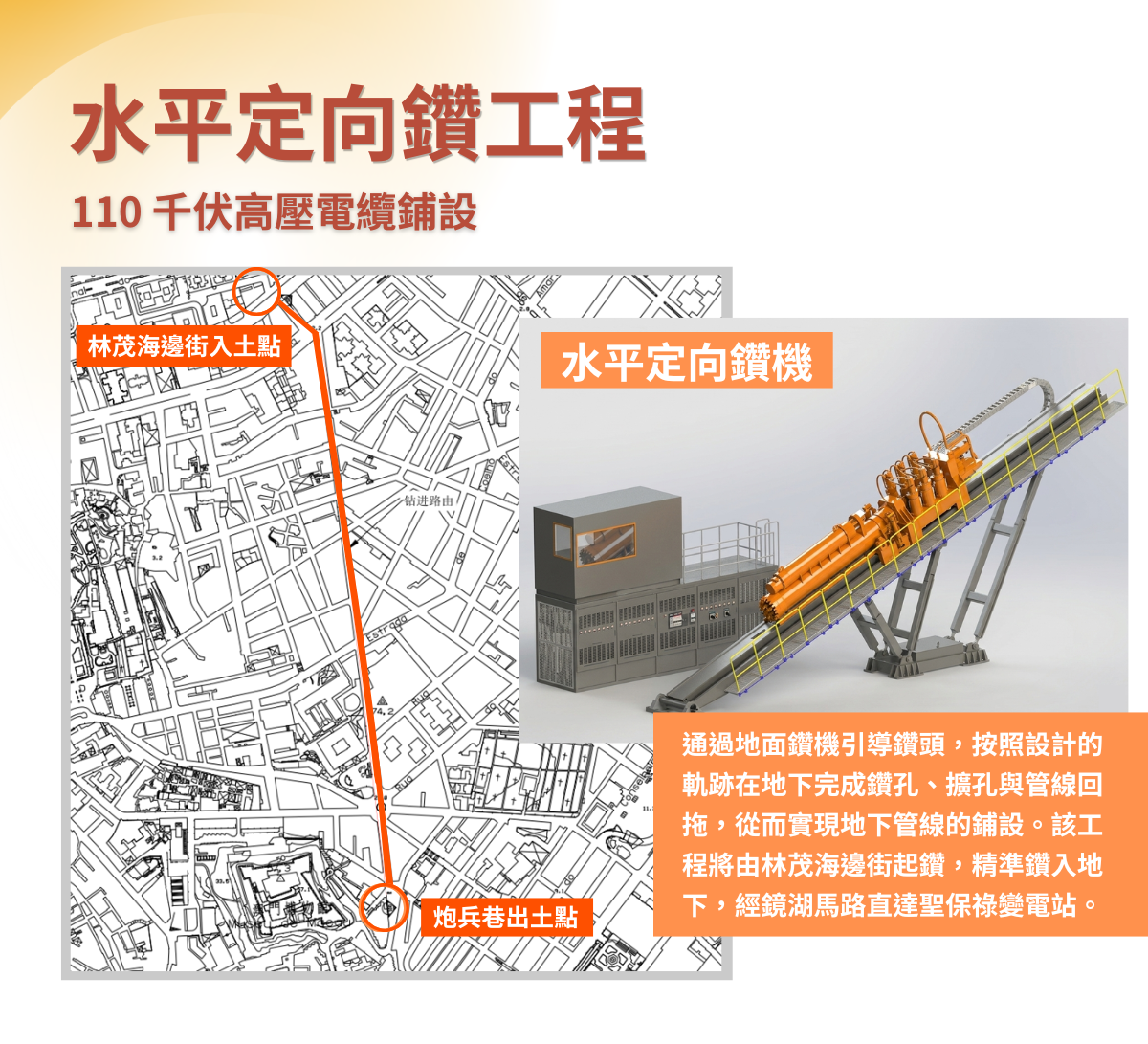


CEM introduces "Horizontal Directional Drilling" for the first time to balance flexible construction and daily commutes
Macao, 5 August 2026
To align with Macao's urban development and growing electricity demand, Companhia de Electricidade de Macau - CEM, S.A. (CEM) is actively investing resources to optimize its transmission and distribution networks, dedicated to enhancing the reliability and stability of the power supply system. Addressing the narrow roads and heavy traffic characteristic of the old districts, CEM will introduce the advanced “Horizontal Directional Drilling (HDD)” method for the first time in the 110kV upgrade project of the São Paulo Substation on Rua dos Artilheiros. Rooted in the core concept of “zero disruption to surface traffic,” the project aims to enhance the local transmission backbone network and the district’s power supply capacity while minimizing the impact on residents' travel and business operations.
As one of CEM's key initiatives to drive grid upgrades, the São Paulo Substation will be upgraded from 66kV to 110kV. This upgrade project will help eliminate intermediate voltage tiers, improve grid efficiency and expand the 11kV distribution cable feeder network. This enables more flexible cross-district power dispatching, effectively satisfying the growing demand for high-quality power supply in both core and new development areas.
Since Estrada do Repouso along the construction route is a major traffic artery in the San Kio district, traditional open-cut road excavation would not only impact traffic but also disrupt the daily operations and lives of nearby hospital, schools, and residents. Following a prudent evaluation by the technical team, CEM decided to introduce the HDD method, which has been widely utilized globally and in major neighboring cities, to lay a section of 110kV high-voltage cable, spanning approximately 900 meters, connecting the Canal dos Patos Substation to the São Paulo Substation.
The drilling will commence from Rua Marginal do Lam Mau, precisely boring deep underground and running through Estrada do Repouso directly to the São Paulo Substation. During construction, the engineering team will utilize advanced drilling rigs to perform underground drilling and reaming, before pulling the entire cable back through the borehole in one go. This innovative construction method offers three significant advantages for maintaining smooth traffic flow in the district:
- It eliminates the need for 900 meters of road closures and detours, keeping major traffic arteries like Estrada do Repouso and Avenida do Almirante Lacerda open. This ensures uninterrupted daily traffic flow for nearby hospitals (such as ambulance access) and schools.
- The entire project only requires construction pits at both ends (the entry point at Rua Marginal do Lam Mau and the exit point at Travessa dos Artilheiros), and all relevant processes are completed underground, replacing traditional "linear" excavation with a "point-based" footprint and freeing up substantial road space for vehicles and pedestrians.
- The project specifically adopts a “single construction, multiple reservations” design concept with pre-installed spare ducts and cables to avoid repeated road excavations for future maintenance or capacity expansion. In the event of future faults or additional power demand, the backup facilities can be activated directly without re-excavating the roads, eliminating secondary traffic burdens on the community in the long run.
While ensuring smooth traffic flow, the project team is also strictly managing construction safety and environmental protection. The team will employ an advanced underground guidance and positioning system to precisely control the drill head's path, and will continuously monitor and strictly control the distance between the borehole and existing underground utilities and buildings, so as to ensure construction safety and prevent any adverse impact on the structures of adjacent buildings. Acoustic curtains will be installed on-site, and all construction work will cease at night. Additionally, a closed-loop mud circulation system will be utilized to trap silt and sand, significantly reducing dust emissions.
Due to the machinery's minimum turning radius requirements and the need to keep adjacent buildings and emergency access routes clear, the current excavation entry point at Rua Marginal do Lam Mau is the only location feasible for construction operations. There are three trees in the affected green belt, including two Mock Bodhi trees and one mango tree. To preserve the largest Mock Bodhi tree on-site, only the smaller Mock Bodhi tree and the mango tree will be transplanted.
CEM will be carefully relocate the Mock Bodhi tree to the green belts within the Hong Kong-Zhuhai-Macao Bridge artificial island’s restricted area and the mango tree to the green belt along Estrada de Nossa Senhora de Ká Hó. The green belt on the Hong Kong-Zhuhai-Macao Bridge artificial island’s restricted area provides a spacious and optimal growing environment with ample sunlight for the Mock Bodhi tree, while the green belt on Estrada de Nossa Senhora de Ká Hó is close to the Ká Hó mountain, where the flowers and fruit of the mango tree can provide food sources for wild animals and enhance the ecological environment.
CEM has always attached great importance to the community environment and public opinions and is actively coordinating with relevant government departments on preliminary publicity, which includes engaging with environmental greening and hygiene focus group of Consultative Committee on Municipal Affairs under the Municipal Affairs Bureau and the Central District Community Service Consultative Council. Earlier, CEM visited the General Union of Neighbor Association of Macao (UGAMM), the Patane Residents’ Mutual Aid Association and the Affiliated Kindergarten of Lou Hau High School to gather opinions on the project. During construction, CEM will display promotional banners on site hoardings to keep local residents informed about the project. Moving forward, CEM will continue to maintain close communication with other community organizations and release further updates to the public in a timely manner, aiming to secure community understanding and cooperation.
Previous Next